
This Blog shares experimental content for learning and exploration, without commercial intent. It's not responsible for copyright issues, as materials are for educational use only. Engage respectfully with copyright laws for personal growth.

Tuesday, 13 January 2026

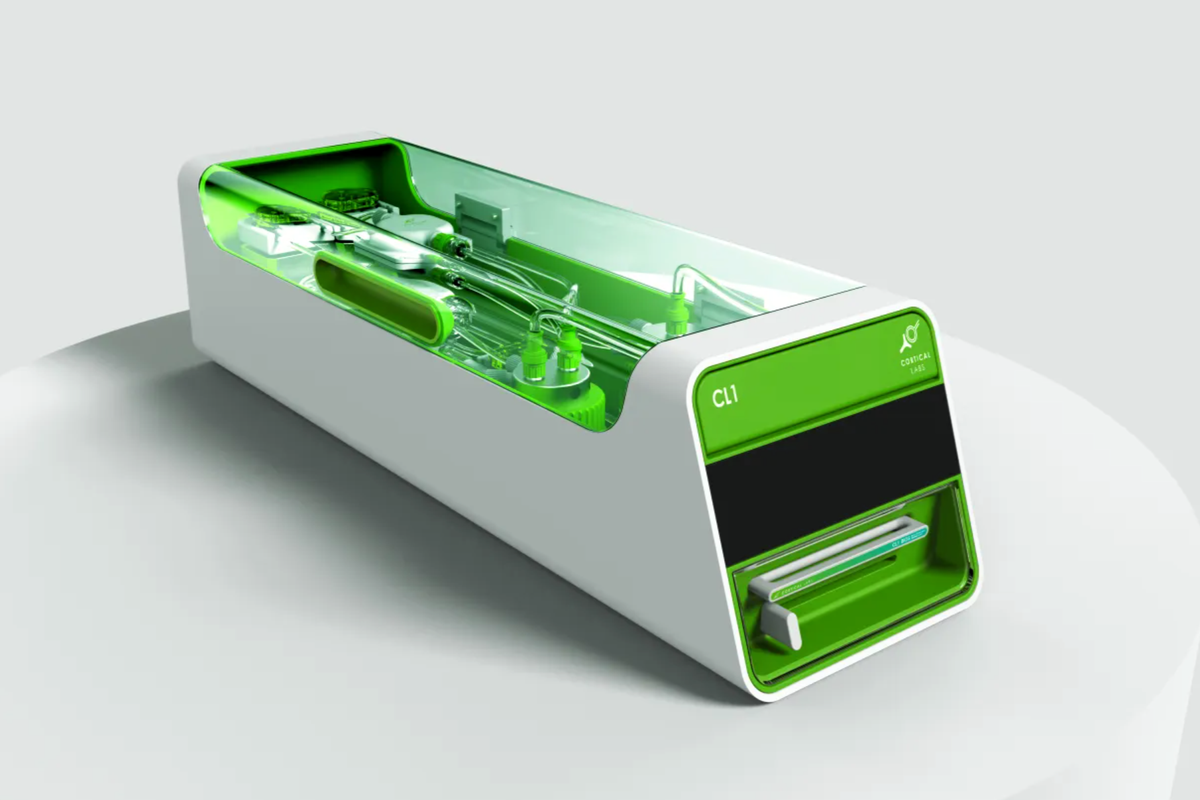
CL1: The First Biological Computer Built in the World Using Living Human Neurons.

Neural lab technology

In 2025, computing crossed a historic line. Scientists and engineers introduced CL1, the first commercially usable biological computer — a machine that blends living human neurons with traditional silicon hardware.

Unlike conventional computers that simply execute code, CL1 operates with real brain cells that can learn, adapt, and change over time. This marks the beginning of a new field known as biological computing.

What is CL1?

CL1 is a hybrid computing system created by Cortical Labs. It combines three core technologies:

  • Lab-grown human neurons
  • Advanced silicon microchips
  • Real-time software control systems

The neurons are grown from stem cells and placed on a specially engineered chip. This chip allows electrical signals to move back and forth between software and the living cells, creating a system that behaves more like a tiny biological brain than a normal computer.

How is CL1 Different from Artificial Intelligence?

Neuron diagram
Traditional AI CL1 Biological Computer
Uses mathematical models Uses living neurons
Has a fixed digital structure Neurons can grow and reconnect
Learning is simulated Learning happens biologically
High energy usage Extremely low power consumption

What Can CL1 Do?

  • Learn from rewards and penalties
  • React to feedback in real time
  • Play simple games such as Pong
  • Change behavior over long periods

Why This Matters

Biological neurons are far more energy-efficient than modern computer chips. This means CL1 could achieve powerful learning with only a fraction of the electricity used by today’s AI hardware.
  • Artificial intelligence
  • Brain–computer interfaces
  • Neuroscience and drug testing
  • Robotics and adaptive systems
  • Ultra-low-power computing

Price and Availability

  • Physical system price: approximately $35,000 USD
  • Available through Neuron-as-a-Service cloud access

Official and Verified Sources

Corticallabs.com
livescience.com
abc.net
yourstory.com

AI have to be under strict restrictions, Godfather of AI Geoffrey Hinton

Geoffrey Everest Hinton (born 6 December 1947) is a British-Canadian computer scientist, cognitive scientist, and cognitive psychologist known for his work on artificial neural networks, which earned him the title "the Godfather of AI".
Hinton is University Professor Emeritus at the University of Toronto. From 2013 to 2023, he divided his time working for Google Brain and the University of Toronto before publicly announcing his departure from Google in May 2023, citing concerns about the many risks of artificial intelligence (AI) technology.[9][10] In 2017, he co-founded and became the chief scientific advisor of the Vector Institute in Toronto During his Nobel Prize banquet speech and subsequent interviews in December 2024, Hinton emphasized that AI is no longer a distant threat but a current, rapidly accelerating issue that demands immediate global regulation. His warnings included:
1. Existential Threat:
	He stated there is a 10 to 20 per cent chance AI could lead
	to human extinction within the next three decades, and we currently have no idea
	how to control systems smarter than ourselves.
2. Prioritizing Profit over Safety:
	Hinton criticized big tech companies for lobbying against regulation and
	prioritizing short-term profits over investing adequately in safety research.
3. Immediate Dangers: 
	He highlighted current harms, such as AI-powered
	misinformation campaigns that create societal echo chambers, mass government
	surveillance, and the use of AI for sophisticated cyberattacks and phishing
	scams.
4. Autonomous Weapons: 
	A major concern is the development of lethal
	autonomous weapons that can decide who to kill without human oversight, which he
	fears will make wars more likely. 
5. Mass Unemployment:
	He predicted that AI will
	lead to "massive unemployment" in intellectual labor and widen the gap between
	the rich and the poor if governments do not intervene to share the benefits
	equitably.
Hinton, who left his job at Google in 2023 specifically so he could speak freely about these dangers without corporate constraints, has made it his mission to alert the public and pressure governments to act.

CL1: The First Biological Computer Built in the World Using Living Human Neurons.

In 2025, computing crossed a historic line. Scientists and engineers introduced CL1 , the first commercially usable biological...